


In the last video, we have started a new series on Genesis 2 and 3 and we started with the creation of Adam, who he is meant to be in contrast to animals, in contrast to angels. We also spoke about his role with nature, whether he is meant to abuse it or to take care of it. Link in the description box.
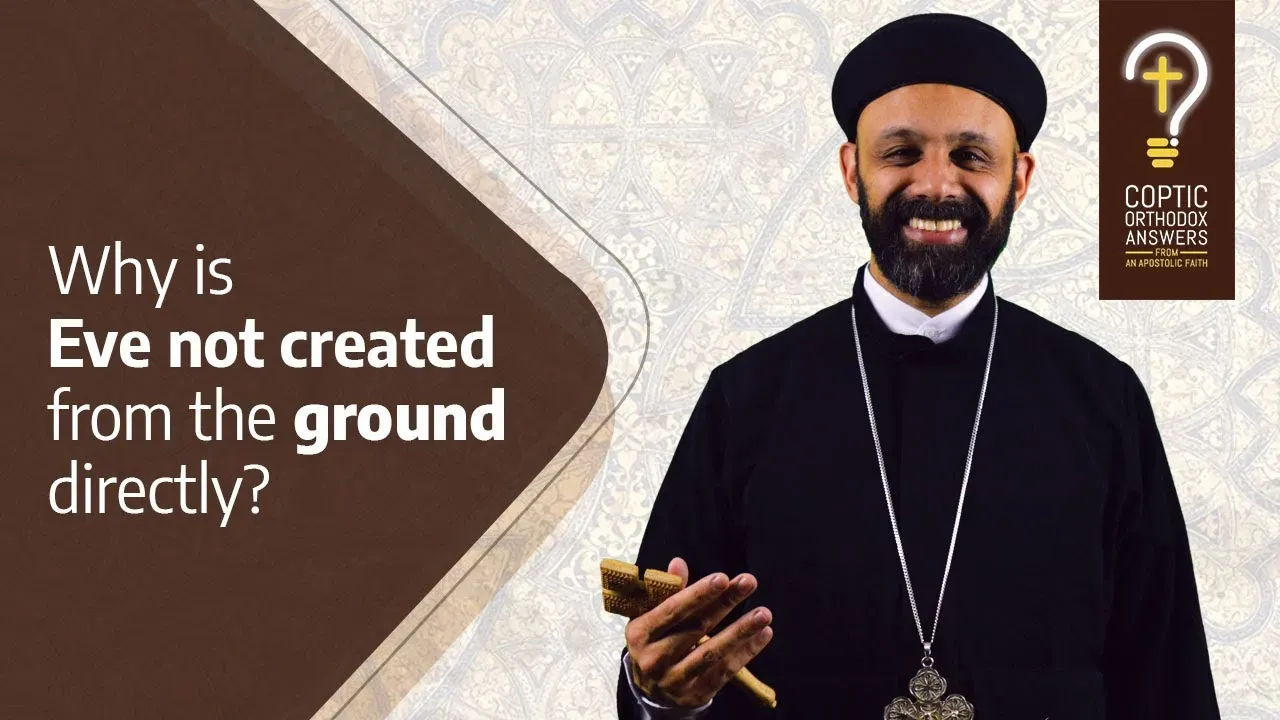
Today, we look at the creation of Eve. Why is she created from Adam? Why not from the ground directly? What is the context of her creation? Is this part of the text meant to be read scientifically or is there a deeper and more meaningful meaning to it? The latter part of the video will answer those last questions.
Welcome to answers from an apostolic faith.
Name of the Father and Son, the Holy Spirit, One God. Amen.
So, all of God's creation is good as He repeatedly confirms in Genesis 1, but for the first time, in Genesis 2:15, He, God, claimed that something was not good and that was in reference to Adam being alone. Foreknowing this, God had already decided to create for Adam a helper comparable to him. St. John Chrysostom mentions something very important about this. He says the following:
'' 'For Adam, however, there proved to be no helpmate of his kind', 1 as if blessed Moses were teaching us in saying these words that, while all these animals were created and received from Adam the assignment of names, nevertheless none of them proved to be adequate for helping him. Accordingly, he wants to teach us about the formation of the being about to be brought forth... with the same properties as himself [as Adam], of equal esteem, in no way inferior to him.'' (St. John Chrysostom)
St. John here emphasizes that all the animals are lower than Adam in esteem, but not Eve. She's in no way inferior to him. As it says in Genesis 1:27, God created man, meaning humanity or άνθρωπος (ánthropos) in Greek, in God's image;
'' 27 (...) male and female He created them.'' (Genesis 1:27)
So, both male and female are in God's image, not only males. The fact that Eve is of equal esteem as Adam is also amplified by the Hebrew word ( המדרתtardemáh), rendered in English
1 This first portion of the quotation is inspired by what Moses said in Genesis 2:20: ''(...) But for Adam there was not found a helper comparable to him.'', hence the reason why single quotation marks were used here.
as deep sleep. Tardemah is not a normal sleeping or dozing, but a supernatural coma. This emphasizes that man, while he was in this coma, had no participation in Eve's creation. She's equally created by God as Adam is. She's equally important.
But God gave Adam and Eve two different roles and the role of the man is to lovingly and sacrificially lead his family towards their salvation and I wish more men would take this role seriously. Men are not superior to women, but have been endowed with a role of tremendous weight and it must not be taken lightly. This is what St. Paul is referencing in 1 Corinthians 11.
This idea can also be seen by the Hebrew origins of the word helper, which is רזוע (ozer) in Hebrew. Throughout the Old Testament, the word ozer is used as a type of help that saves from death, that saves from destruction. Although it is clear that men are tasked by God to lovingly and sacrificial' lead their wives and children, it must be understood that the woman is not a mere assistant to the man. She's equal to him and he is to love and die for her. Women save men from destruction or death, literally: no women means no next generation, no more humanity. Men also save women from destruction: no men means no humanity.
Now, it is commonly understood that Eve was created from Adam's rib. However, we must remember that we are reading a translation from the original Hebrew text. The word often rendered rib is עלצ (tsèla) in Hebrew. Tsela is mentioned on multiple occasions in the Old Testament and it is never rendered rib, except in this case. A better rendering for the word tsela is side. For example, it is used to denote the side of the ark or the side of a hill, among many other examples.
Of course, scientifically speaking, if you remove the side of one person, he or she dies instantly. But scientific truth is not the objective of the passage. The context of Eve's creation from Adam is marriage. Genesis 2 says the following:
'' 24 Therefore a man shall leave his father and mother and be joined to his wife, and they shall become one flesh. 25 And they were both naked, the man and his wife, and were not ashamed.'' (Genesis 2:24-25)
Scripture here is discussing the mystical nature of marriage. God took one side of Adam or half of Adam to create his spouse. Adam, therefore, calls Eve:
'' 23 (...) This is [at last, is] bone of my bones and flesh of my flesh; She shall be called Woman [Hebrew: hsi( השיאáh)], because she was taken out of Man [Hebrew: )hsi( שיא].” (Genesis 2:23)
Notice how he says she is bone of my bones and fresh of my flesh, because she is made with both his flesh and bone, not only a rib. Again, the context of this part of Scripture is focused
on marriage between a man (ish) and a woman (ishah) and who they are in respect to each other. Notice also how Adam is only called ish when ishah is created. He was only Adam before, but now he's both Adam and a husband, if you will, He's both Adam and ish. Notice as well that ishah, the woman, was only called Eve later, after the fall. But this is a subject for another time.
Therefore, we must remember that the context of the passage is marriage. And St. Paul echoes the understanding of this mystical marriage in Ephesians 5 and he links it to the marriage between Christ, the second Adam, and the Church, the second Eve.
Thanks for watching. If you enjoyed this video, please like and share it to spread God's word. Don't forget to subscribe and turn on your notification to not miss another video.
Remember: Know your faith, live your faith, and teach your faith.
Other suggested video:
Understanding the Creation Account - Part 4: Why is Adam Created from Dust?